
Blog · 26 September 2026 · 6 min read
Eighteen months of Kowalski: an architecture that kept getting smaller
From a weekend Ollama wrapper to one binary that answers questions about your spreadsheets: eighteen months of diagrams, and why almost every good change removed something.
Kowalski started on 4 March 2025 as a weekend experiment: a Rust program that could talk to a local Ollama model. Eighteen months, 721 commits and a dozen releases later, it is a single binary that small-business owners can download, point at their spreadsheets, and get a report workbook back from.
Looking back at the diagrams we drew along the way, one pattern stands out. Almost every good change removed something: a crate, a dependency, a process, a layer, and finally the model's authority over numbers. This is the story of those removals.
March 2025 — "Hello, Ollama" (0.1 to 0.3)
The first three releases arrived in six days. 0.1.0 was, in the changelog's own words, "proof that
we could make it work, and a lot of hopes and dreams": a CLI, one Ollama connection, streaming
replies. 0.2 added conversations, roles, and PDF and text input; 0.3 a proper command line with
kowalski chat, kowalski academic and model management.
There was no architecture yet, and that was fine. The useful thing we learned was what an "agent" had to be in this codebase: a model, a conversation, a role (a system prompt) and some way to pull documents in.
June–July 2025 — The Great Restructurization (0.5)
Then we drew the architecture we thought we needed.
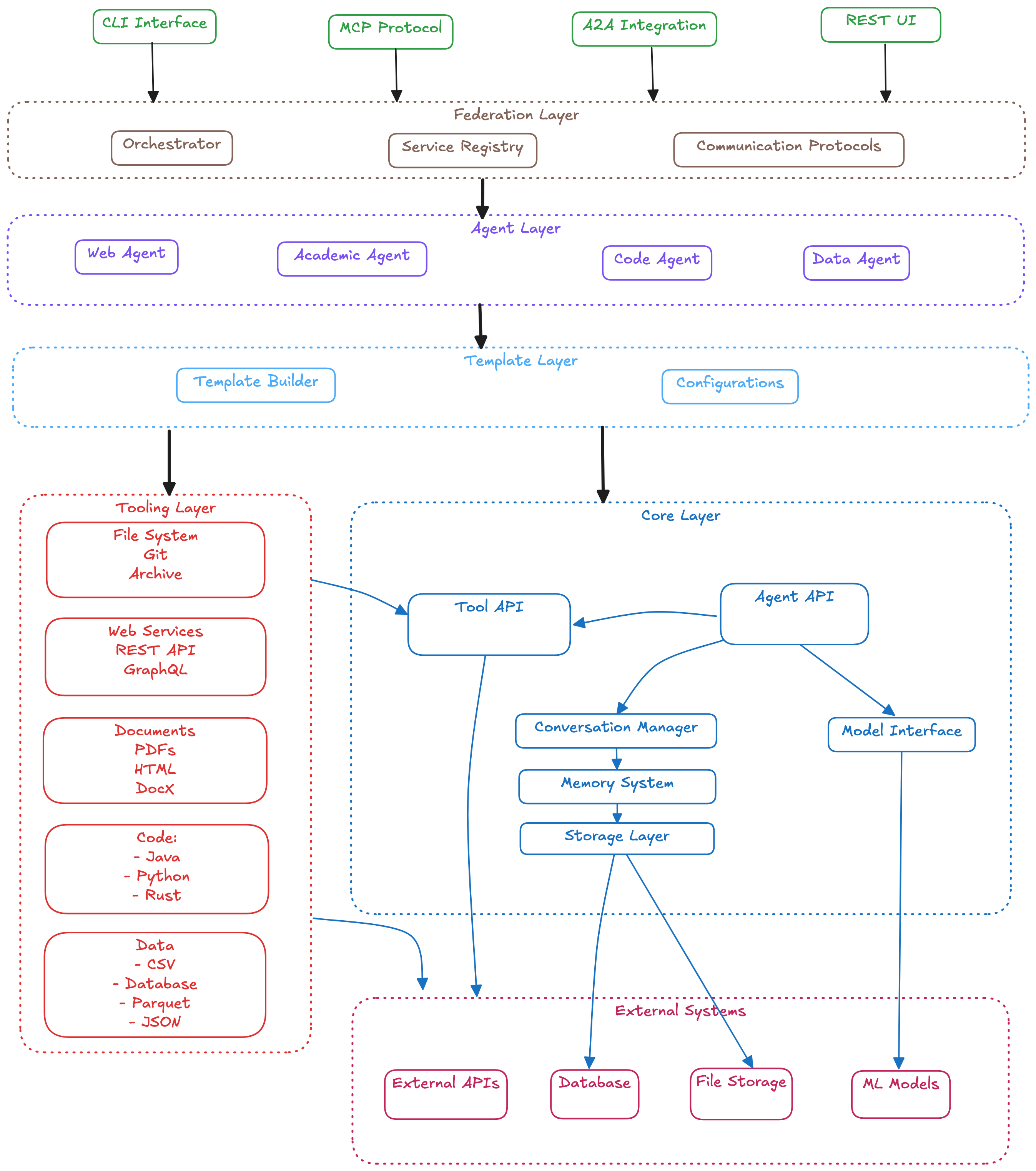
Five layers: a Federation layer (orchestrator, service registry, communication protocols) on top of an Agent layer (web, academic, code and data agents), a Template layer, a Tooling layer that promised file systems, Git, REST, GraphQL, PDFs, DOCX, Java, Python, Rust, CSV, Parquet and more, and a Core layer with its own memory system and storage layer. Four front doors: CLI, MCP, A2A and a REST UI.
0.5.0 made it real as a workspace of many crates: kowalski-core, kowalski-agent-template,
kowalski-tools, kowalski-federation, and one crate per agent. Memory got the full treatment:
Qdrant for vectors in a proof of concept, RocksDB for the episodic log, petgraph for relations.
June and July 2025 were the busiest months the project has had: 226 commits.
It was a good exercise and a bad product. Each agent crate was a slightly different copy of the same idea (a model with a different system prompt and a different tool list). Each dependency was a daemon to run or a native library to build. The federation layer described a distributed system nobody was running. And nothing in it could be handed to someone who does not write Rust.
February–April 2026 — Consolidation (1.0)
After a quiet autumn, 1.0 undid most of 0.5, deliberately.
- The agent crates collapsed into one
TemplateAgent. A persona is configuration plus a prompt plus a tool list, not a crate. - The memory stack went dependency-light. RocksDB became a SQLite file through
sqlx.petgraphbecame aHashMapof edges ("one fewer dependency; same behaviour for the current query pattern"). Qdrant stayed a proof of concept; semantic memory defaults to in-process vectors, with Postgres and pgvector as an opt-in feature. - An HTTP server and a Vue UI appeared, so the thing could be used without a terminal.
- MCP became the way to reach tools, with the first data server: DataFusion over CSV and Parquet, which would later become tableski.
April 2026 alone had 171 commits, most of them deleting or moving code. The guiding sentence, written into the design notes then and still true: prefer simple, robust defaults with minimal moving parts.
April–June 2026 — Hordes (1.1 to 1.4)
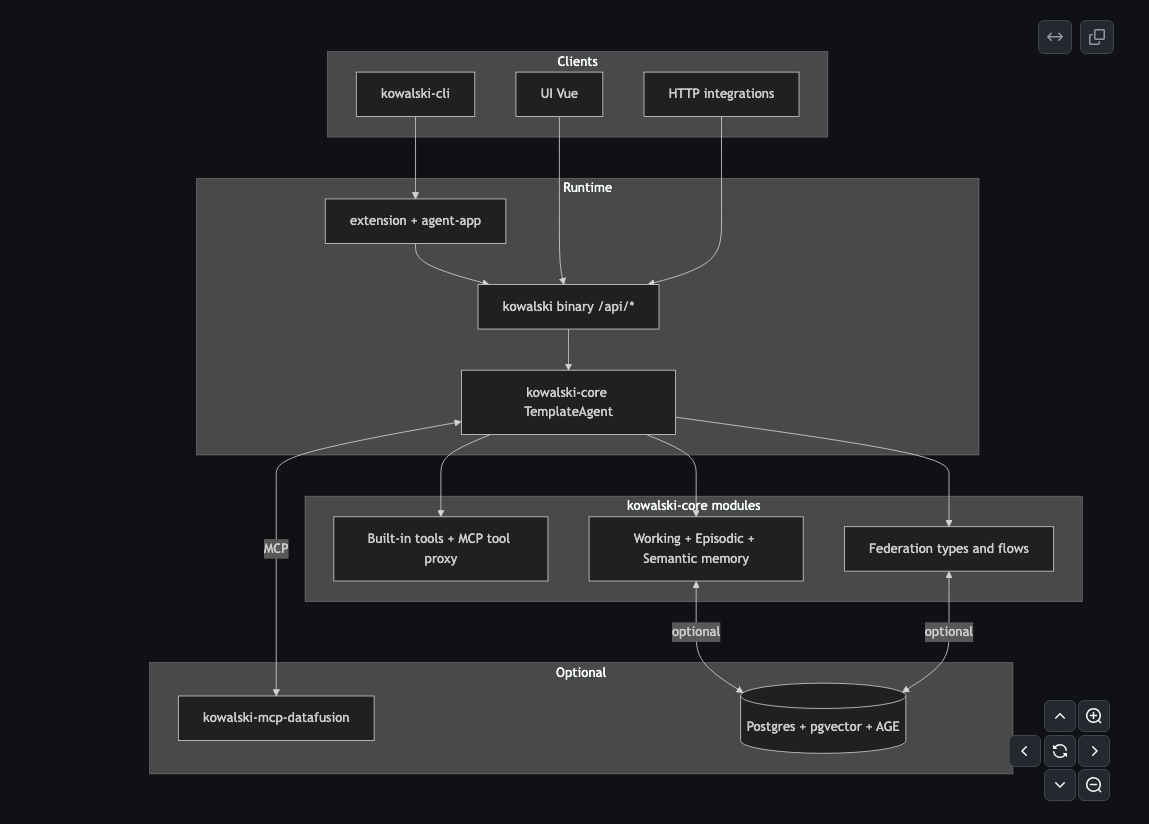
The 1.2 picture is already recognisable: clients on top, one kowalski binary serving /api/*,
kowalski-core with tools, memory and federation types, and optional pieces at the bottom. What it
does not show is the idea that arrived in 1.1 and gave the project its shape: the horde.
A horde is a folder. horde.md names a pipeline; each file in agents/ is one step (we call them
penguins); prompts are Markdown. The first one, the Knowledge Compiler, ran ingest → compile → ask
→ lint and wrote Markdown artifacts you could read. No database schema, no UI-only format: a
horde can be diffed, copied and reviewed like any other file.
1.3 added the Rookery, a builder that writes horde folders from a conversation, and made it an MCP server of its own. 1.4 turned pipelines into graphs with fork, join and loop-back edges. In this era, steps still ran as separate worker processes that registered with the server over a federation protocol, the last living piece of the 0.5 federation layer.
August 2026 — Autonomy and Ecosystem (1.7, 1.8)
1.7 removed the workers. Every standard step kind now runs inside the server through a step handler registry, with process isolation as an opt-in for code you do not trust. In exchange, runs became durable: every transition is written to SQLite before it takes effect, and a restart resumes where it stopped. Hordes gained triggers (cron, file watch, webhook), so they could work without anyone clicking, and portable bundles, so they could move between machines.
1.8 removed things from the repository itself. The MCP server framework became emperor-mcp and the DataFusion server became tableski, both standalone projects. The workspace shrank to four crates, with a policy to keep it that way: new servers get their own repositories.
September 2026 — The product (2.0, 2.1)

The latest picture has one black frame: one process, started by one command, holding the UI, the API, the horde runner and the agent core. Everything outside it is chosen by the user: a model, a data tool, the web.
2.0 made that frame literal. The UI and the built-in hordes are compiled into the binary; a Setup screen writes the config (three questions: model, files folder, tableski sign-in). 2.1 added standing orders (a Morning Brief on a schedule, a Folder Watcher on an inbox), download-and-run binaries, and defaults that ask before a step runs a command.
The most important change of the whole eighteen months is small and easy to miss in the diagram. In the Spreadsheet Analyst, four of six steps use no model at all: one profiles the tables through tableski, one runs the SQL, one builds the workbook. The model writes the queries and explains results it is handed. It never produces a number.
We got there by watching a 7B local model fail. Asked to profile tables with tools, it printed the tool call as text instead of making it. Asked to write SQL without an exact schema, it queried a table that does not exist. Every such failure point became a plain, deterministic step, and the model was left with the one job it does well. A wrong query now fails loudly in the engine, instead of quietly in a report.
What eighteen months taught us
- Delete layers you are not running. The 0.5 federation layer described a system we did not have. Its last trace, worker processes, went in 1.7, and nothing got worse.
- Dependencies are daemons someone has to keep alive. Qdrant, RocksDB and
petgrapheach made sense alone. Together they made kowalski hard to install. SQLite and aHashMapcovered the real use. - Make the unit of work a file. Hordes as folders made everything else easy: review, version control, a builder that writes them, bundles that move them.
- Give the model less to do. The more a step matters to correctness, the less of it should depend on sampling. Engines compute; models write.
- Ship the frame, not the parts. Nobody wants four crates. People want one thing that opens in a browser and answers a question about their spreadsheet.
The full current architecture, with diagrams of one run and of the run lifecycle, is in
docs/architecture.html. Kowalski is open source at
github.com/yarenty/kowalski.